Welcome Xuepei, we are very excited to have you today with us to discuss about your work.
Who is Xuepei Hou and how did the passion for creating begin?
I am a director and cinematographer from Beijing. Right after pendemic ended, around 2022, I moved to New York for film school. For me, it has been an inevitable path leading towards film. I studied music as a child and dreamt about being a conductor growing up, I love the feeling of being precise with note and the romance of stretching your body to tell the most woeful story. Later I discovered theatre in college and from then on, I was mesmorized by the musicality in visuals. For me, different art form has a universal pattern that speaks to each other, and film is the perfect vessel for someone ambitious to achieve maximum creativity.
Can you tell us a bit about your previous work?
I worked for a publication in Beijing and was their in house docuseries director. The experience of being in the field talking to people from all walks of lives bring me perspective that inspires me to make films that showcase more than what my life defines. But also, it made me look inward and not afraid to face what scares me and cannot be fixed. My first short film “The Adults Are Talking” is an autobiographical drama, it is a coming-of -age story of a young college graduate only child facing the decay of her parents’ health. The brutality of life and death was suddenly presented with the upmost honesty and irony.
Every film begins with a spark. What was the first image, emotion, piece of music, or personal experience that inspired Stoptime Rag?
My biggest inspiration is Scott Joplin’s, Bethena: A Concert Waltz”, a piece he wrote shortly after the death of his second wife. I am a big fan of Joplin since I discovered Jazz and trace backwards.
I was deeply moved by the meloncholy melody and the synopation of the classic rag style, very much reflecting the insyconicity of two people who want different things in life, especially the decision of weather keeping this relationship or themselves alive. Sometimes, someone can be so close to you yet so far away.
CONVERSATION ABOUT: ‘‘Stoptime Rag’’
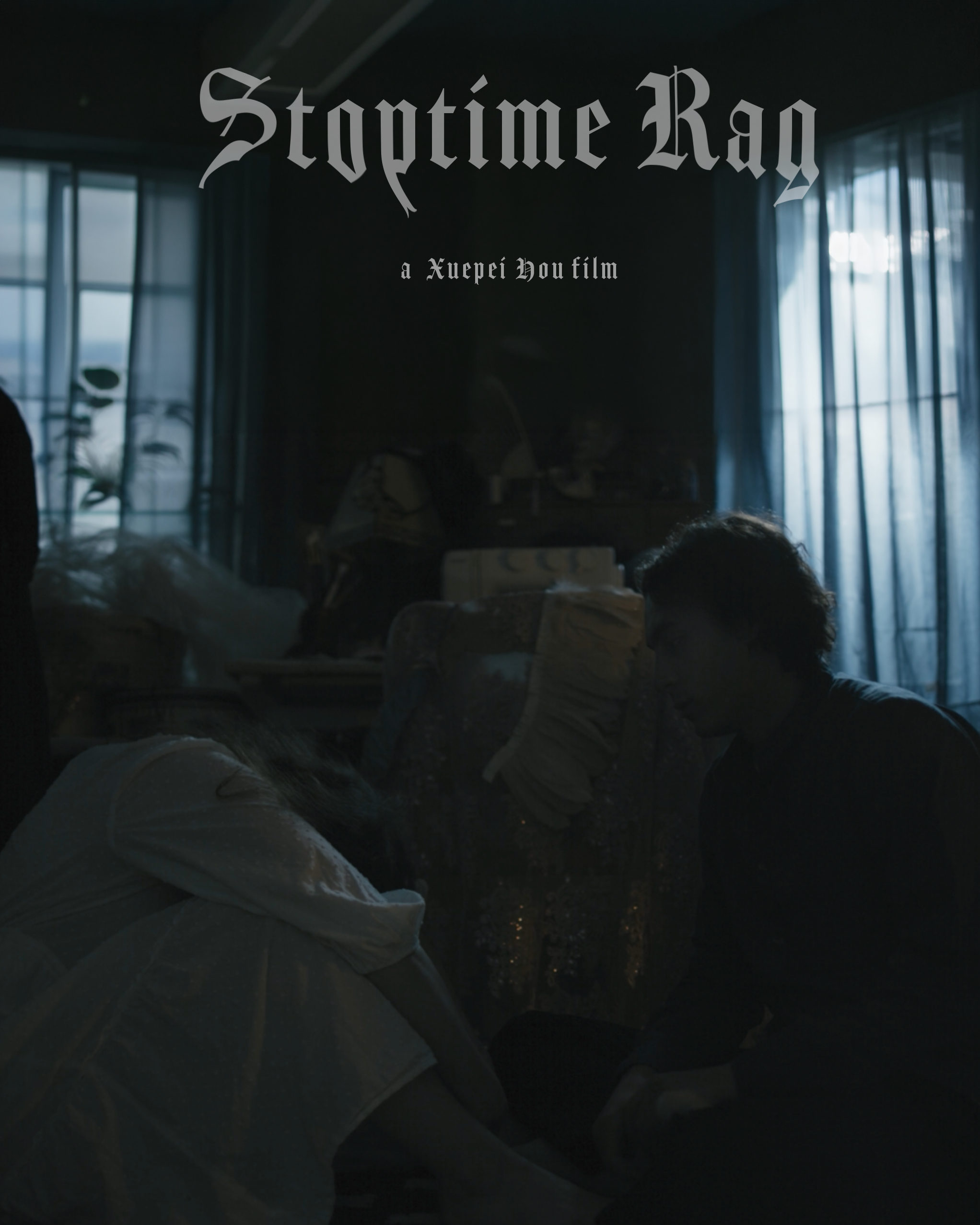
Stoptime Rag is described as a modern dark fairy tale. What attracted you to fairy-tale storytelling as a way of exploring grief, psychological isolation, and emotional vulnerability?
Many fairy tales are usually percieved as scary tales. I found preserved fear are usually hidden behind those innocent children stories. When reality doesn’t make sense to us as a kid, our fight or flight instinct tries to make connection to things that are familiar to us. Having that imaginary horror being tangible fairytales is my way of dealing with things that doesn’t have any resolution. The same fear from childhood never get old even as we gets older. If anything, the vulnerability only gets louder and the monsters in our dream starting to have more blood and bones. When I read about Dr. Pauline Boss’s concept of “ambiguous loss,” that feeling finally had a name. Ambiguous loss is a loss without certainty or closure: someone who disappears, a relationship that ends without explanation or goodbye, a person who is still here but no longer the same. The anger and confusion it leaves behind can keep the living stuck, with a hole in their hearts that never fully closes. And that kind of loss is universal.
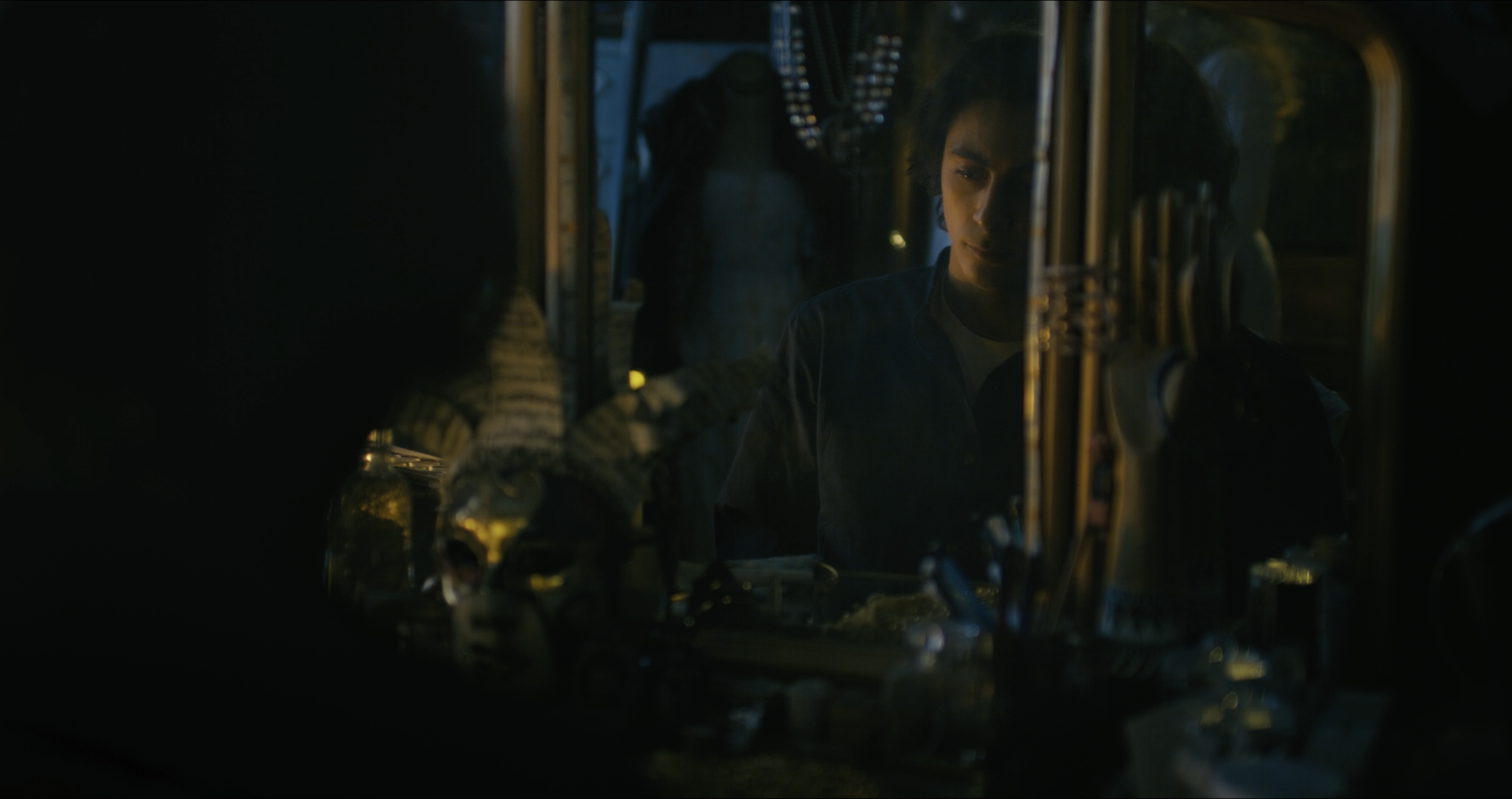
Your director's statement suggests that we sometimes create hallucinations to survive. At what point does a coping mechanism become something that threatens to consume us?
In the film, the brother Noé created this world where he and his twin sister Collete lived in, and only the two of them. The brother is the sun and the sister is the moon. The sun gets all the glory in broad day light, have different advantures every day and the sister fade away in her castle of solitute. She tried to tell her brother that she is not with him, he didn’t understand him. And the miscommunication has forever being cast upon the two who used to be bonded by fate and blood. In the film, Noé found closure by having a conversation with his deseased sister in his imagination. However, one could only hope all our visions of loved ones are this kind. When it doesn’t, that might consumes us in the fastest and most brutal way.
Were there particular filmmakers, composers, painters, or literary works that influenced the film's dark fairy-tale atmosphere?
Pan's Labyrinth by Guillermo del Toro’s and Double life of Veronique by Krzysztof Kieślowski are two of the biggest influences for my style. Both film discuss dual identity in lavishing but precise visuals. It suits the story so well like a surgical knife that cut reality apart from their surrealistic world building.
Was there a moment during filming or post-production when the project revealed something unexpected about itself and changed your original creative intentions?
During the edit, I cut a major thread of the sister’s storyline where her backstory no longer felt relevant to her relationship with her brother. In a short film, it’s nearly impossible to do justice to two perspectives. So in the end, I chose to make the story more streamlined.
In future projects, do you plan to explore similar genre intersections, or are there other genres you're eager to explore ?
Absolutely. I love thrillers, and I believe many nuanced human emotions are better carried in the vessel of a genre film. Genre makes those emotions more accessible to an audience than asking them to sit through a straightforward premise about a tortured sibling. In the future, I welcome all kinds of genres. I recently dabbled in comedy and realized that horror and comedy have a lot in common: both are about the rhythm of visuals and lines. You have to be confident and precise with your shots. Hold a shot too long or cut it too short, and the payoff doesn’t land.
What would you most like audiences to carry with them after the final image fades the sorrow of what has been lost, the possibility of reconnection, or a question about their own relationship with memory?
I want the audience to feel like a child being tucked into bed: safe and taken care of. All the sadness and unresolved feelings are just a bad dream lingering in the back of our minds. Like ashes, like snow, they are not meant to last. But in the moment, they are all we can think about; they occupy and consume our thoughts. As I like to remind myself, this too shall pass. The good and the bad, our memories do not last forever. You have to believe that.