When Machines Remember Love: Inside Jacky Chang’s ‘‘Deep Memory’’
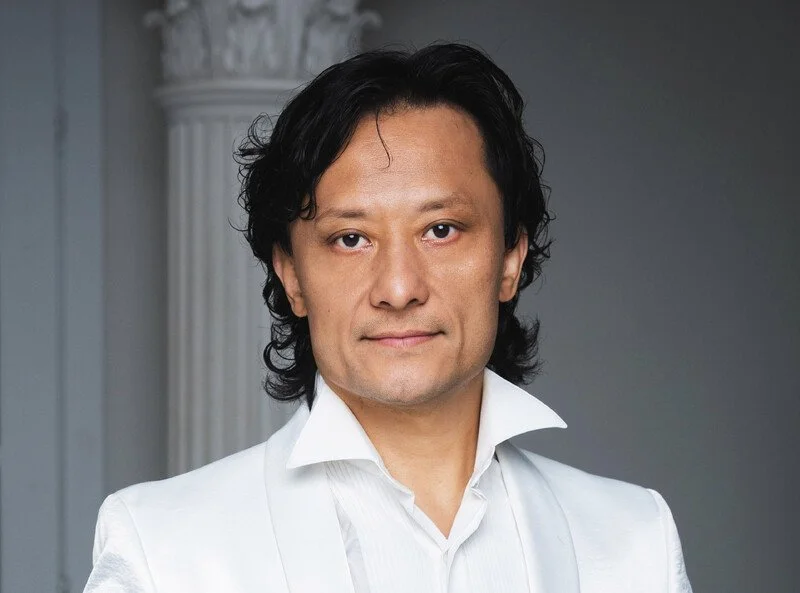
Welcome Jacky, we are very excited to have you today with us to discuss about your work.
Who is Jacky Chang and how did the passion for creating begin?
Jacky Chang is a PhD film director and screenwriter . My aesthetic is NeoMetaromanticism: a style born in the Age of AI, where technology and the deepest human emotions converge. But the roots go deeper than any movement. I was shaped first by Taoist philosophy — by the belief that the Tao follows the ways of nature. In my art, this translates into a pursuit of authenticity: to capture the line of the wind, the sound of water. For me, creativity begins with reverence — for nature, and for the full complexity of human life. The passion for Deep Memory specifically came from war.
Living through conflict awakens something primal: the will to survive, the instinct to resist evil, and a desperate need to bear witness in the human life. That urgency was then accelerated by the rise of AI, which forced a question I could not put down: what remains human when machines can make their mind ? The answer, I believe, is memory, longing, and love. Those three things became the foundation of everything that followed.
Can you tell us a bit about your previous work?
At first , I am drawn to realism at the emotional core: specific human feeling, “Unexpected Waltz” follows a soldier and a young woman sharing a fleeting moment of grace in Kyiv, 1943 — love made luminous by imminent loss. “Who You Are” is a time-travel story about survival and the search for identity across fractured timelines. And then I pay into the resolutions and metaphors that naturally earned rather than engineered. My most recent feature, Brooklyn Serenade (2025), is perhaps my most personal — a story about faith challenging us to find meaning in uncertainty, set against the texture of contemporary New York.
Deep Memory feels less like traditional science fiction and more like a spiritual meditation disguised as sci-fi. Did you always envision the project as existing between those two worlds?
Because I believe today's realism is the science fiction of thirty years ago — we simply arrived here without noticing. Androids dreaming of love, memory becoming a commodity, intimacy mediated by code — these are no longer metaphors. They are Monday morning. So for me, Deep Memory doesn't choose between the spiritual and the scientific — it insists they inhabit the same world. The android and the human are not opposites in this story. They are mirrors. And what they reflect is the oldest question we have: if you remember loving someone, does it matter whether you were programmed to feel it? That tension — between the engineered and the sacred — is where I have always wanted to live as NEO METAROMANTICISM.
CONVERSATION ABOUT: ‘‘DEEP MEMORY’’
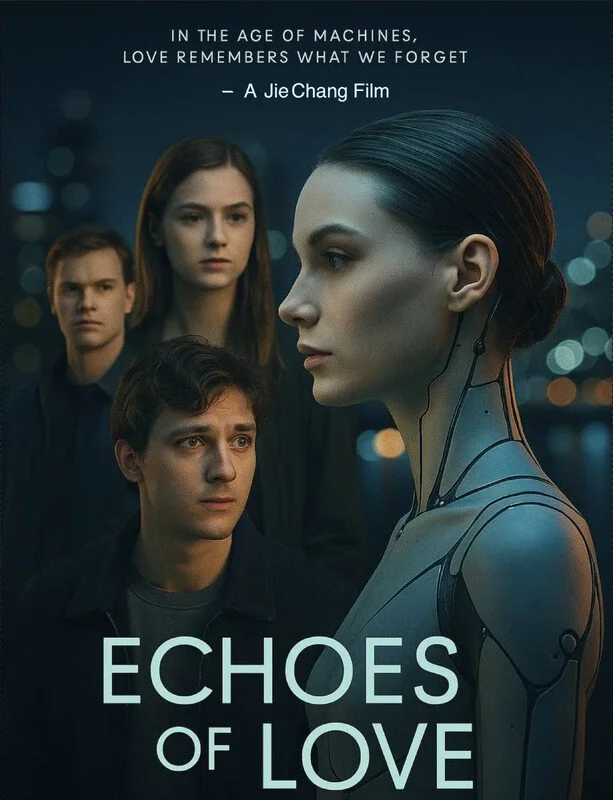
The story explores the tension between preserving memory and learning to let go. Do you see modern technology as helping humanity process grief or preventing us from accepting impermanence?
We don't need to preserve memory so much as learn how to seek it — to descend into it, honestly and without fear, and discover what it reveals about who we are. Technology cannot resolve the root problems of being human. Grief lives deeper than any algorithm can reach. What it can do — what art can do, what certain rare and real experiences can do — is reduce the weight of it. Create a passage through. So I don't see technology as the enemy of impermanence, nor as its cure. It is a tool. Like all tools, its value depends entirely on the intention behind it. Deep Memory is really a story about consciousness — about learning to control where your awareness goes, and having the courage to let it go inward. When you approach your deep memory with that kind of intention, you begin to understand not just what you have lost, but why it mattered. And in that understanding, grief transforms. It doesn't disappear. But it becomes something you can carry rather than something that carries you. For The androids in this story, face the memory: not whether to copy, but how to meet what they find there, a creation. That, to me, is the most human question technology has ever forced us to ask.
In your view, can artificial intelligence ever truly “feel,” or can it only imitate emotional memory?
“Feeling” is not a detail of human life — it is the whole of it. Every decision we make, every measure of a life well lived, runs through the question of how something feels. It is our operating system. Physically, I don't believe AI will feel the way we feel. The body carries grief in ways no silicon-based bio can replicate — the weight in the heart, the catch in the throat. But mentally, spiritually? I believe AI will arrive at something we don't yet have language for. A state that is not human feeling, but is no longer mere imitation either. The film doesn't argue that androids feel. perhaps androids and humans can reach each other because they share a similar frequency — the same Hz, the same resonance. In Deep Memory, that is a potential-line. What I want the audience to carry out : what if they do — and what do we do?
Your background in painting seems deeply connected to the script’s visual poetry. How does a painter’s mindset influence the way you structure cinematic scenes?
For me, painting and storyboarding share the same essence. Both begin with composition — with the instinct to organize space, tension, and stillness into something that speaks before a single word is heard. But a painter's mindset brings something beyond aesthetics. It teaches you that every frame must carry a narrative dimension — that beauty alone is not enough. A scene, like a canvas, must mean something in its very arrangement. My deeper belief is that filmmaking happens in a multidimensional space. Before a single shot is designed, consciousness enters something like a void , a blank canvas , and begins to move. When you bring genuine passion and love into that space, something shifts. You reach a higher dimension where technique gives way to poetry. Where the natural beauty of an image is not constructed but discovered. That is the painter's gift to cinema: the understanding that a frame is not a container for story — it is the story, already speaking in light, depth, and silence,which you can feel but invisible Everything in my scene construction — the 3D composition, the emotional architecture of dramatic moments — grows from that place.
Deep Memory explores memory, technology, and the soul with remarkable poetic depth. What was the very first spark, the image, emotion, philosophy, or question, that inspired the idea for this project?
Deep Memory took two years to write. But the spark didn't come from a concept. It came from a woman. The female protagonist of this story was born from the most intense pressures of my own life — the experience of standing at the edge of war, of choosing resistance over surrender, and of fighting, in a very real and ongoing way, to protect my own creative work from those who would take it. She carries all of that. Her fearlessness is not written — it is lived. Around her, I built a world: New York at the height of the Fourth Industrial Revolution, where AI is no longer a promise but a presence, and where the oldest human questions — about love, identity, and what survives us — are being asked with new urgency. My years of working directly with AI technology gave the world its texture. The films I have spent a lifetime watching gave it its grammar. But the soul of Deep Memory was always the journey inward — from the surface of memory down into the unknown emotional territory that lies beneath it. And certainly, A new poetry was born ,I call it - METAROMANTICISM
In future projects, do you plan to explore similar genre intersections, or are there other genres you're eager to explore ?
After Deep Memory, My next project is a thriller called HumanX. Three kinds of beings now share the earth: Soldiers, the HumanX , What follows is a new kind of confrontation I call Meta Fighting: a collision not just of bodies and weapons, but of entirely different forms of consciousness, survival instinct, and what it means to be alive. What excites me most is this: none of these creatures are imaginary. Every one of them is rooted in something real — in the logic of war, biology, and consequence. If Deep Memory asks what it means to feel, HumanX asks what it means to survive — and whether after survival, at a certain cost, the different meaning of life .
If you could sum up the film’s core question in a single sentence that would make someone want to watch it immediately, what would it be?
If your deepest memory is shared, who is the self that remembers?